
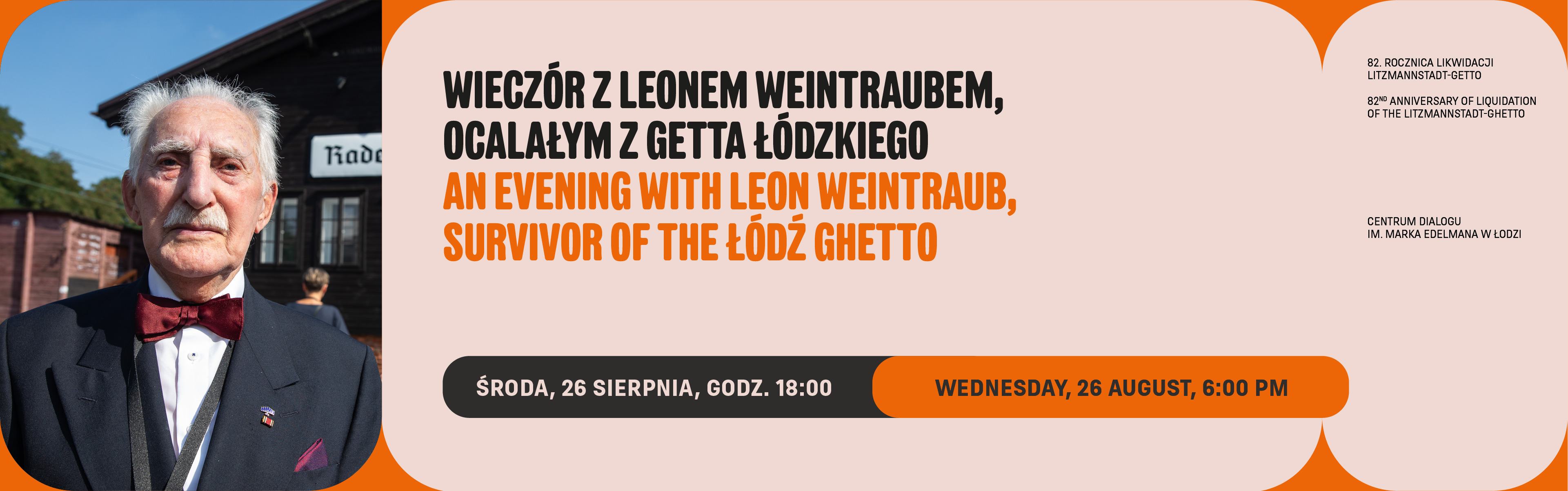
On August 26 at 6:00 p.m., we invite you to a special event dedicated to Dr. Leon Weintraub—a native of Łódź who survived the Łódź Ghetto and the Auschwitz-Birkenau, Gross-Rosen, and Flossenbürg camps; a physician; an Advocate for Reconciliation; and an Honorary Citizen of the City of Łódź. On this day, the documentary “L’dor vador,” produced by two young German filmmakers—the brothers Dean and David Körzdörfer—will also have its world premiere.
It’s worth joining us, because—as Yad Vashem Chairman Dani Dayan says—“We are at a generational crossroads—nothing can replace looking into the eyes of a Survivor.”
It’s worth joining us, because—as Yad Vashem Chairman Dani Dayan says—“We are at a generational crossroads—nothing can replace looking into the eyes of a Survivor.”
The event program includes:
 World premiere of the film “L'dor vador,” directed by Dean and David Körzdörfer (rated 16+);A conversation by Michalina Majewska (@Kino po Żydowsku) with the film’s subject, Leon Weintraub, and its filmmakers, Dean and David Körzdörfer.
// 26.08.2026 g. 6:00 PM
// Venue: Dialogue Center (Centrum Dialogu)
// Registration required at: This email address is being protected from spambots. You need JavaScript enabled to view it.
// The event will be held in English, with translation into Polish and Polish Sign Language
// The film shown is intended for viewers min. 16 years old.
Accessibility:
// The event will be held in English interpreted into Polish and Polish Sign Language (PJM)
// The film “L'dor vador” (16+) will feature subtitles in Polish and English
// The event will be held in English interpreted into Polish and Polish Sign Language (PJM)
// The film “L'dor vador” (16+) will feature subtitles in Polish and English
// About the film “L'dor vador” //
The documentary presents a year in the life of Leon Weintraub—born in Łódź, living in Stockholm since 1969. The camera accompanies him to memorial sites, during discussions with youth, conversations with his wife, and in moving dialogues with his children: Emilia Rotstein and Robert Weintraub.
It is a story of intergenerational responsibility and how wartime trauma is passed down from generation to generation—l'dor vador (Hebrew for from generation to generation).
“Forgetting would mean taking the victims' lives all over again”
— Emilia Rotstein, daughter of Leon Weintraub
This statement serves as the conceptual core of the film and will be the starting point for the discussion with the audience.
It is a story of intergenerational responsibility and how wartime trauma is passed down from generation to generation—l'dor vador (Hebrew for from generation to generation).
“Forgetting would mean taking the victims' lives all over again”
— Emilia Rotstein, daughter of Leon Weintraub
This statement serves as the conceptual core of the film and will be the starting point for the discussion with the audience.
// Guests of the Evening //
Leon Weintraub – born on January 1, 1926, in Łódź. He spent his childhood on Kamienna Street (today’s Włókiennicza Street). During the German occupation, he and his family were forced into the Litzmannstadt Ghetto, where he worked, among other jobs, as an electrician. In 1944, he was deported to Auschwitz-Birkenau, from which he escaped by cleverly sneaking into another transport. He survived the Gross-Rosen and Dörnhau camps, as well as a death march.
After the war, he completed medical studies and worked as a respected gynecologist and obstetrician in Warsaw and Otwock. As a result of the anti-Semitic purge in 1968/1969, he was forced to emigrate to Sweden. For decades, he has been actively involved in Holocaust education and Polish-Jewish-German dialogue, rejecting notions of hatred and revenge in favor of reconciliation.
After the war, he completed medical studies and worked as a respected gynecologist and obstetrician in Warsaw and Otwock. As a result of the anti-Semitic purge in 1968/1969, he was forced to emigrate to Sweden. For decades, he has been actively involved in Holocaust education and Polish-Jewish-German dialogue, rejecting notions of hatred and revenge in favor of reconciliation.
Filmmakers:
Dean Körzdörfer – born in 2002 in Hamburg. He studies philosophy at the Humboldt University of Berlin and worked as a volunteer for Yad Vashem in Germany, where he met Leon Weintraub during a reading at a synagogue. That is when he came up with the concept for the film L’dor vador. Together with his brother David, he visited Leon Weintraub in Stockholm, accompanied him to Poland, and traveled to Israel to speak with Dani Dayan.
David Körzdörfer – Dean’s brother, born in 1996 in Hamburg. He began his film education in 2014 as a personal assistant to Oscar-winning director Florian Gallenberger. From 2015 to 2020, he studied directing at HFF Munich. For the past 10 years, as a filmmaker and journalist, he has been covering conflicts in the Middle East and Eastern Europe. For the ARD documentary film “Bêmal – Heimatlos” (2024, 88 min), he received the Human Rights Youth Jury Award and the Stern-Preis (formerly Henri Nannen-Preis) for Best Documentary in 2025.
// Accessibility //
The event is taking place at the Centre for Dialogue in the Theatre and Cinema Hall, which is equipped with an induction loop. The Centre for Dialogue building is accessible to people with mobility impairments. It has wide, non-automatic entrance doors, an accessible toilet and a lift. The theatre hall is on the ground floor and has a ramp; there are spaces for wheelchair users in the auditorium. There is a large car park in front of the building, with designated parking spaces for people with disabilities. Assistance dogs and guide dogs are permitted in the building and the auditorium. The building is equipped with the ToTuPoint audio navigation system. Access to the car park is from Wojska Polskiego Street. Nearby bus and tram stops include: Wojska Polskiego/Centrum Dialogu and Wojska Polskiego/Sporna.
The event accompanies the commemoration of the 82nd anniversary of the liquidation of the Litzmannstadt Ghetto.