
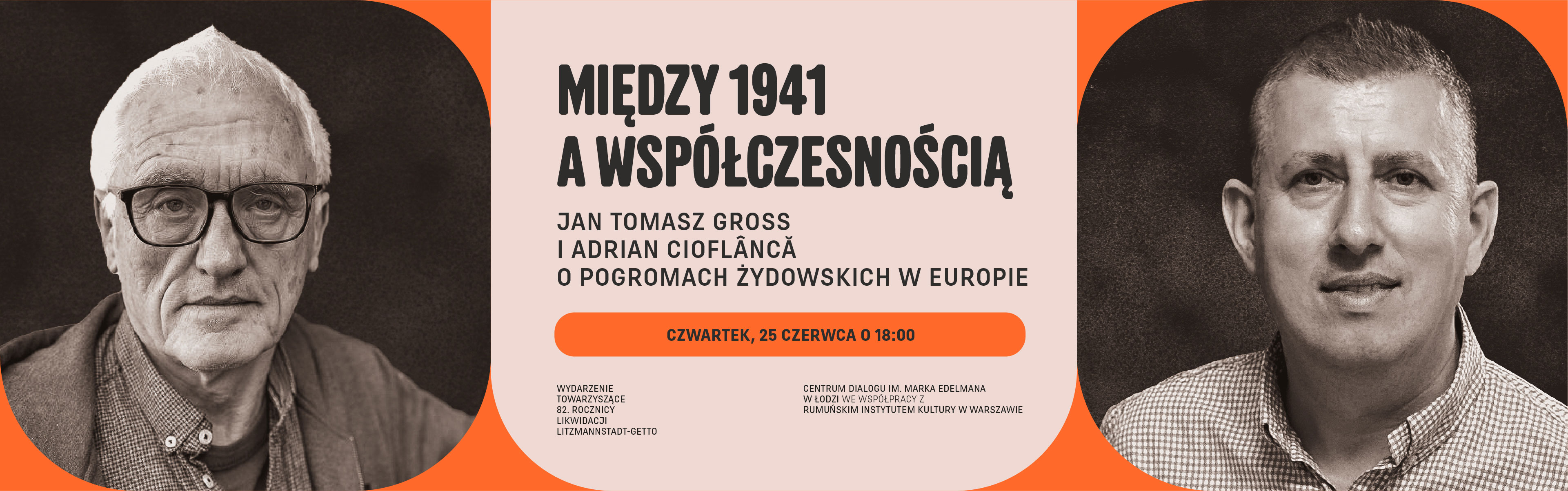
When: June 25, 6:00 PM
Where: Dialogue Center, Wojska Polskiego 83
The Marek Edelman Dialogue Center in Łódź and the Romanian Cultural Institute in Warsaw cordially invite you to a meeting dedicated to the history of anti-Jewish violence in Europe and contemporary ways of confronting a difficult past.
The guests of the event will be historian and sociologist Jan Tomasz Gross, author of numerous publications on the Holocaust and Polish-Jewish relations, and Romanian historian Adrian Cioflâncă, a researcher of the history of antisemitism and the Holocaust in Romania. The discussion will be moderated by Przemysław Witkowski.
The starting point for the conversation will be the 85th anniversary of the pogroms in Jedwabne and Iași. The participants will discuss the mechanisms of anti-Jewish violence, the memory of these events, and how democratic societies relate to their own history. A key element of the meeting will be a comparison of the Polish and Romanian experiences, alongside a reflection on the impact of historical memory on contemporary social life.
The event is organized as part of the Pop-up Romania program and will accompany the commemoration of the 82nd anniversary of the liquidation of the Litzmannstadt-Ghetto. It is part of ongoing initiatives dedicated to the history of the Holocaust, the memory of its victims, and the contemporary debate on the heritage of multicultural Europe.
The event will be held in English with simultaneous translation into Polish. Interpretation headsets will be available for attendees who require translation into Polish.
Biographies
Jan Tomasz Gross is one of the most prominent contemporary sociologists and historians. His works on Polish history, the Holocaust, and Polish-Jewish relations have had a profound impact on both historical research and public debate. He is a Professor of History Emeritus at Princeton University, where he held the Chair in the History of 20th Century Wars. He studied sociology and earned his Ph.D. from Yale University in 1975. From 1975 to 1984, he taught at Yale University, specializing in sociology and Soviet studies. He then served as a Professor of Sociology at Emory University in Atlanta (1984–1992), and from 1992 to 2003, he taught political science and European studies at New York University.
He has been a fellow of prestigious foundations, including Fulbright, Guggenheim, Hoover, and Rockefeller, and a visiting professor at numerous renowned institutions, such as Harvard University, Stanford University, University of California Berkeley, Columbia University, as well as universities in Paris, Vienna, Kraków, and Tel Aviv. He is the author of many groundbreaking publications, including Neighbors: The Destruction of the Jewish Community in Jedwabne, Poland (2000), Fear: Anti-Semitism in Poland After Auschwitz (2006), Golden Harvest (2011), as well as Polish Society under German Occupation: The Generalgouvernement, 1939–1944 and Revolution from Abroad: The Soviet Conquest of Poland's Western Ukraine and Western Belorussia.
For his scholarly achievements, he has been honored with numerous awards and decorations, including the Knight's Cross of the Order of Merit of the Republic of Poland, awarded by the President of Poland Aleksander Kwaśniewski in 1996. In 2021, he ranked 13th among the world's most influential historians in a ranking prepared by Academic Influence.
Adrian Cioflâncă is a historian specializing in the history of antisemitism and the Holocaust. He currently serves as the Director of the Wilhelm Filderman Center for the Study of Jewish History in Romania, operating under the Federation of Jewish Communities in Romania, and works as a research fellow at the A.D. Xenopol Institute of History of the Romanian Academy. He has conducted archival research in Romania, Israel, the United States, Moldova, and Ukraine, focusing on the issues of antisemitic violence in Europe. He utilizes archival and photographic materials for both scholarly and public outreach work, publishing on platforms such as Scena9 and Revista 22, and co-creating documentary films.
Together with Radu Jude, he co-directed the documentary films: The Exit of the Trains (Ieșirea trenurilor din gară, 2020), Memories from the Eastern Front (Amintiri de pe Frontul de Est, 2022), and Plan contraplan (Shot/Countershot, 2025). He has also participated in fieldwork related to the identification of mass graves and Holocaust memorial sites. In 2003–2004, he was a member of the International Commission on the Holocaust in Romania, co-authoring its final report, based on which the Romanian state officially recognized its responsibility for participation in the Holocaust. Since 2005, he has been a member of the Romanian delegation to the International Holocaust Remembrance Alliance (IHRA). In 2009, he was a Tziporah Wiesel Fellow at the United States Holocaust Memorial Museum in Washington, D.C. He is the co-editor of eight scholarly volumes, the latest being a thematic issue of Revista de Istorie a Evreilor din România titled Against Antisemitism: The Activity of Wilhelm Filderman as Leader of the Jews in Romania (2025). He has published numerous studies on the history of the Holocaust, communism, political violence, and cultural history.
Przemysław Witkowski – Assistant Professor at Civitas Academy (Uniwersytet Civitas); author of Glory to Supermen: Ideology and Pop Culture (2017), The Laboratory of Violence: A Political History of the Roma (2020), The Coming Fascism (2023), and The Russian Party (2023); former advisor to the Minister of Culture and National Heritage and member of the political cabinet of the Ministry of Culture and National Heritage; since 2024, Deputy Director of the Gabriel Narutowicz Institute of Political Thought.